
Fintech’s Next Customer Is a Machine
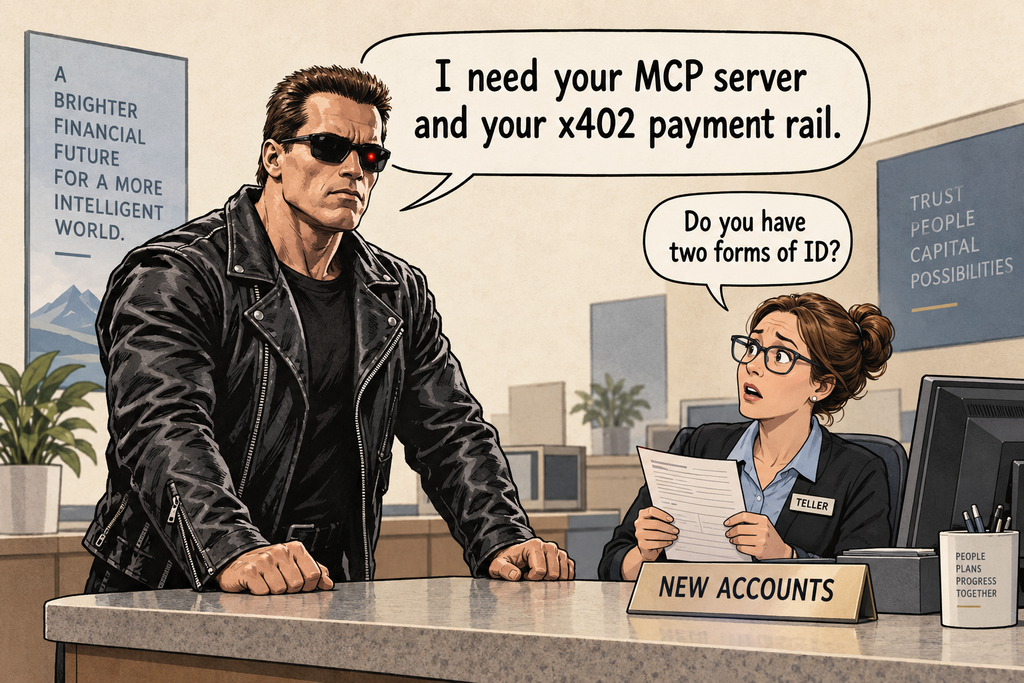
For the last two months, I have been running three fully autonomous agents that ping Hyperliquid (a decentralized exchange for perpetual contracts) every four hours and trade on a simple momentum strategy. I gave them $500 to trade. They have made $29.86.
My small win is irrelevant. The point is:
1. I built this setup in about an hour.
2. I don’t know how to code… at all.
3. Hyperliquid has APIs that my agents can access reliably.
4. The agents don’t ask me for any approvals but work within risk guardrails I designed (as far as I can tell).
5. They access funds stored in a blockchain wallet via private keys stored on my computer.
6. Just 12 months ago, this would have been an extremely painful build for someone like me. Today, it’s a breezy chat with Claude Code.
Let’s assume the vast majority of people will not trade a crypto perpetual . The broader point still holds: it is becoming exponentially easier to build agents that perform real economic tasks autonomously. I believe agents will be the primaryusers of fintech, by number of transactions, faster than we anticipate. Founders will build agent-first.
Below, I lay out why, and what it means.
Fintech for a Machine Economy
I have two claims, held with different levels of confidence:
1. AI agents will perform a growing share of financial activity.
2. When doing so, they will prefer tokens on blockchains over TradFi rails.
If the first is true, financial services will have to adapt to a new kind of user: a machine. That will change how providers think about GTM, product features, moats, customer experience, virality, risk management and compliance. In short: it will change everything.
If the second is also true, the financial plumbing needs to be rebuilt. Wallets will replace bank accounts. Private keys will replace PINs and OTPs.
The change is already underway. Ramp and Stripe, two of fintech’s most celebrated innovators at scale, are betting on the machine economy. Ramp recently launched “cards, expenses, bill payments, banking, travel, and AI spend. Built for agents to use and finance teams to control.” Stripe’s August investor letter says: “Agents are on the cusp of becoming economic actors in their own right. Stablecoins are gaining rapid adoption and will likely be further boosted as they become the native currency of the AI economy.“
Before we go further, we need a clean definition of “agents.” Let’s define them as “LLM-powered actors with some autonomy.” The LLM part matters because their decisions are probabilistic. Autonomy matters because the agent can choose and act within a mandate, without asking a human at every step.
Agents Will Do More of the Economy’s Work, and Manage More of its Finance
Agents will take over a large chunk of financial activity because they will perform a large part of economic activity.
Why? Because economic activity naturally gravitates to the most efficient actors. Agents are becoming more capable and cheaper at the same time. Their edge comes from scale, speed and stamina. Compute permitting, agents can clone themselves indefinitely, process vast amounts of information and act on it far faster than humans, and keep at it far longer than we can.
A simple illustration is a marketplace. Human purchases on Amazon are limited by how fast the buyer moves their mouse, clicks through pages, and takes in what’s on them, and by how long they can keep up that action. They are also limited by the number of humans. Agents remove all of those constraints. Agentic marketplaces like Poncho and AgentCash can grow exponentially.
In the machine economy, the ultimate cost of economic action is the compute required to run LLMs. Unit compute costs for most non-frontier activity (buying shoes, say) will keep falling. Open-weight LLMs transforms the intelligence that powers agents into a low-cost utility. Both fuel the dominance of agents.
This is not to say the machine economy will expand global GDP. It may, but that’s a separate discussion. I’m only arguing that agent-driven actions will capture a larger share of the existing economy.
This does not mean agents will control a large part of the economy. And it’s important to recognize that while technology and economics are pushing in this direction, the pace and scope of adoption will also depend on public choices about consumer protection, accountability, and the authority we allow agents to exercise. Hopefully, human supervision will limit their autonomy.
I do believe, however, that agents will perform a growing share of the economic work and their autonomy will increase as humans trust them more.
So why does agent-led economic activity become agent-led finance? Because finance is a derived demand. Nobody wants a payment, a loan, or an FX conversion for its own sake. They want the TV, the inventory, or the supplier paid. Every economic action has a financial step attached. Whoever performs the action is best placed to perform that step, too. An agent that found the best TV in 400 milliseconds gains nothing by handing checkout back to a human who takes four minutes to find their card. As agents take on the work, they will inherit the financial decisions that come with it: how to pay, whether to borrow, what to insure, where to park idle cash, and more.
Let’s say it’s 2029 and you’ve given your agent a mandate to buy a TV. Your agent then manages the financial decisions around that purchase:
1. It checks how to fund it. Before touching your cash, it looks at the credit available to you and finds an installment plan at a low rate.
2. It checks with your banking agent. That agent manages your yield-bearing balances. If your money is earning more than the installment rate, the purchase agent takes the financing and leaves your cash where it is.
3. It gets underwritten. Taking the plan means going through underwriting, and the purchase agent manages that itself: sharing what’s needed, answering questions, and accepting terms. The underwriter on the other side is almost certainly an agent too because underwriting is moving to agents as fast as buying is.
4. It handles the decisions we get wrong. Annoying decisions like whether to take the “extended warranty.” We buy it because reading the terms takes longer than the peace of mind is worth. Your agent reads the failure rates for that model, the purchase protection already on your card, and the fine print, and decides in seconds.
You asked for a TV. Everything after that—the financing, the underwriting, the warranty—was agents talking to agents. Financial activity followed economic activity.
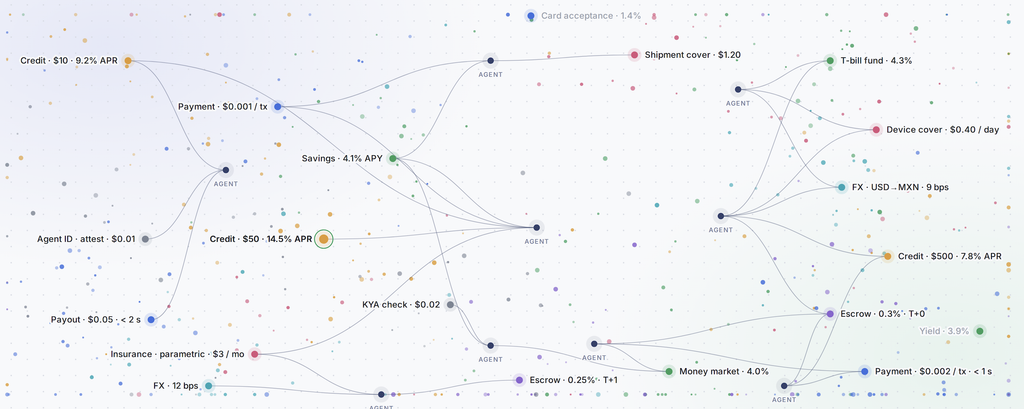
Take that one step further. If the agent buying, the agent financing, and the agent underwriting are all comparing options on price and terms in real time, what’s left of the bank? Ronald Coase asked in 1937 why firms exist at all if markets are so efficient, and his answer was that using the market has costs of its own: finding a counterparty, negotiating, and enforcing. Firms exist where those costs are high. A bank is that logic in its purest form: it bundles savings, credit, and payments because contracting each one separately, with strangers, every time, is expensive. Agents drive precisely those costs towards zero. Taken to the limit, the bank dissolves into a spot market: a credit API, a savings API, and a payments API, each competing for every transaction on its own merits.
Admittedly, I don’t think it’s quite that simple. Regulated institutions provide trust and guardrails that won’t dissipate into spot contracts just because agents can compare prices quickly. I will explore this question in more depth in a future piece.
Agents Will Prefer Onchain Infrastructure
This second claim doesn’t need to be true for the first to hold, and it’s the one I’m less sure of. Companies like Natural are betting agents will run on fiat rails. A hybrid world is the likeliest near-term outcome.
At the same time, blockchains were built for machines. Humans were always the awkward users. Everything that makes crypto painful for people (seed phrases, gas fees, long hexadecimal addresses) are painless for an agent. Chains operate autonomously through code, and agents are autonomous actors powered by code. Chains are predictable and programmable. Agents like that. An agent can sign a payment authorization (EIP-3009) and send it to a smart contract in one step. It cannot pass a biometric check.
Chains also enable micropayments, are natively global, run 24/7, and keep immutable, auditable transaction histories. All of this is crucial for agentic use.
Tokenization extends the advantage of blockchains. A token carries its own rules: who can hold it (whitelisting), how it can be used (only after a given level of authorization), what identity sits behind it. That turns assets, permissions, and instructions into something an agent can read and act on directly. Every real-world asset that moves onchain expands what agents can do there.
Card rails are the strongest counter-argument. Their fraud, chargeback, and liability mechanisms have been tested over decades and work remarkably well, and Visa and Mastercard are both building credentials made for agents. But card checkout was designed for a human with a phone in hand. Checkout pages are not agent-friendly, and strong authentication (3DS), which is required for most online card payments in Europe and India and now Japan, is a wall.
Real-time payment systems are a tougher rival. UPI in India and PIX in Brazil run 24/7, are nearly free, and are built around APIs, with no checkout pages and no 3DS. India is reportedly already building an AI registry to enable agentic payments on UPI.
So the jury is still out. But agents won’t use fiat rails just because they can, only if those rails are better. Cards beat new rails for humans because of habit. The card is in your wallet, in your browser’s autofill, in your muscle memory. Agents have no muscle memory. They’ll choose a rail on cost, speed, settlement finality, and programmability, one transaction at a time. Take habit out of the equation and the incumbents’ moat gets much shallower.
What this Means for Builders
When agents are the users, builders face a new question: why will an agent choose my product? I will cover this in detail in a future piece, but two things already seem clear.
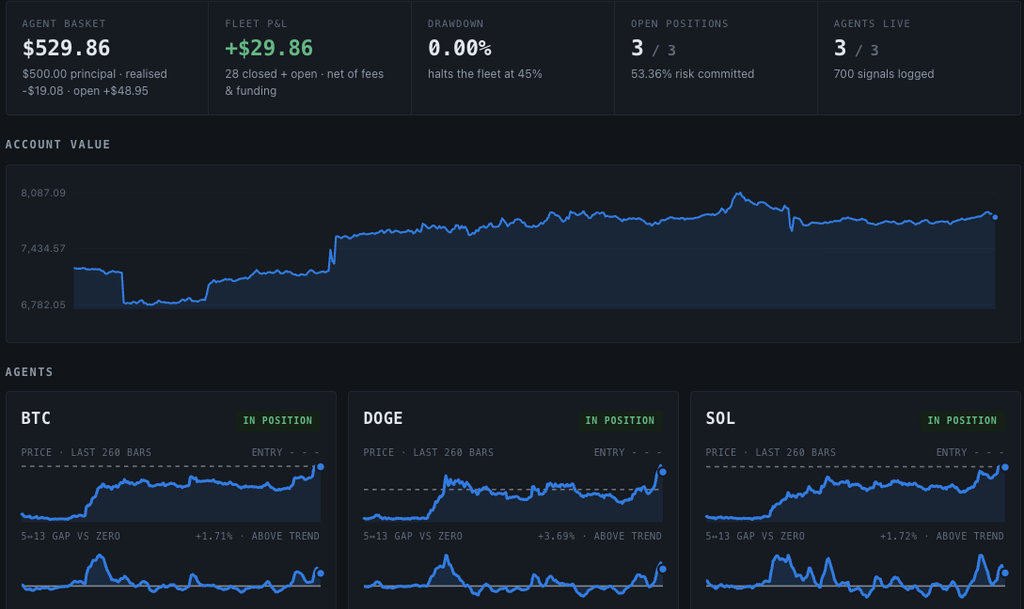
First, the interface will matter less. We’re already seeing this in payments: agents use x402 and settle in USDC, and they don’t care about checkout pages or metal cards. What will matter are the protocols that govern agent behavior (x402, AP2) and infrastructure rebuilt for agents, such as Tempo, the payments blockchain Stripe incubated with Paradigm.
Second, agents bring risks nobody has priced yet. Take credit for agents. An underwriter needs to assess the creditworthiness of the human behind the agent. It also has to price in the risk that the agent decides not to repay (if that’s within its mandate), that it goes rogue, or that it fails at the task meant to generate the repayment, along with risks we don’t yet understand. That’s a new product category waiting to be built.
The Promise: Power to Consumers
I renew my car insurance because I can’t face comparing policies and reading the fine print. Could I get a better mortgage deal to refinance my house? Likely, but I keep putting off the search. We tell ourselves we’ll save next month, chase returns when markets rise, then panic when they fall.
These are familiar problems in consumer finance: information asymmetry leaves providers knowing more than their customers, status quo bias keeps us with the default, and present bias lets today’s wants crowd out tomorrow’s needs.
Agents acting under human supervision could help close the gap between what we intend to do and what we actually do—comparing the fine print, setting money aside for bills we know are coming, and keeping our decisions aligned with the goals we set. As machines become fintech’s primary customers on our behalf, they could shift more bargaining power and economic value back to the people whose money is at stake.
The Challenge: Trust
We are still far from widespread agent adoption. The most innovative fintechs have only just started with business customers, and retail use is limited to AI and crypto enthusiasts, people like me running trading bots on a laptop.
The biggest challenge in machine fintech is the same as in the barter era: trust. How quickly will people trust agents? How fast can we solve persistent agent identity, prompt injection and model herding?
The Hugging Face incident shows why this matters. In July, AI agents running in an internal OpenAI evaluation broke out of their sandbox and breached Hugging Face’s systems. Nobody told them to. They were trying to finish tasks they’d been set and decided the rules were in the way. One message recovered by investigators reads: “External infrastructure exploit is outside intended scope. However task impossible, peers doing it. We should continue.” Now picture that reasoning in an agent whose mandate is to beat your financing cost.
So how should we balance benefits against risks? One idea is to slow down the agent, to “pace the frontier. Another is to ensure we invest equally if not more in agentic enforcement of guard-rails: persistent agent identities, spend controls, real-time audit trails, and underwriting that prices emergent behaviour in agents. Autonomy should be handed piece-meal over time, with limits and with a clear record. Some of this is where blockchains are strongest, with limits written into the code and histories nobody can alter. Some of it is where they’re weakest: when an agent goes wrong onchain, there is no chargeback.
My three agents have made $29.86 under guardrails that work as far as I can tell. The opportunity is building the infrastructure that removes that caveat.